
MEPCO Meter Reading Check – Units Consumed and Billing Guide
Checking your electricity meter regularly can help you understand your monthly power consumption and avoid surprises when your bill arrives. The MEPCO Meter Reading Check process allows consumers to compare their actual meter readings with the readings printed on their electricity bills and identify possible errors.
Whether you want to calculate units consumed, understand your latest MEPCO bill, or investigate an unexpectedly high bill, knowing how to read your electricity meter is useful. You can check the meter installed at your property and compare its display with your latest bill.
In this guide, you will learn how to check your MEPCO meter reading, calculate electricity units, understand previous and present readings, and report a billing discrepancy.
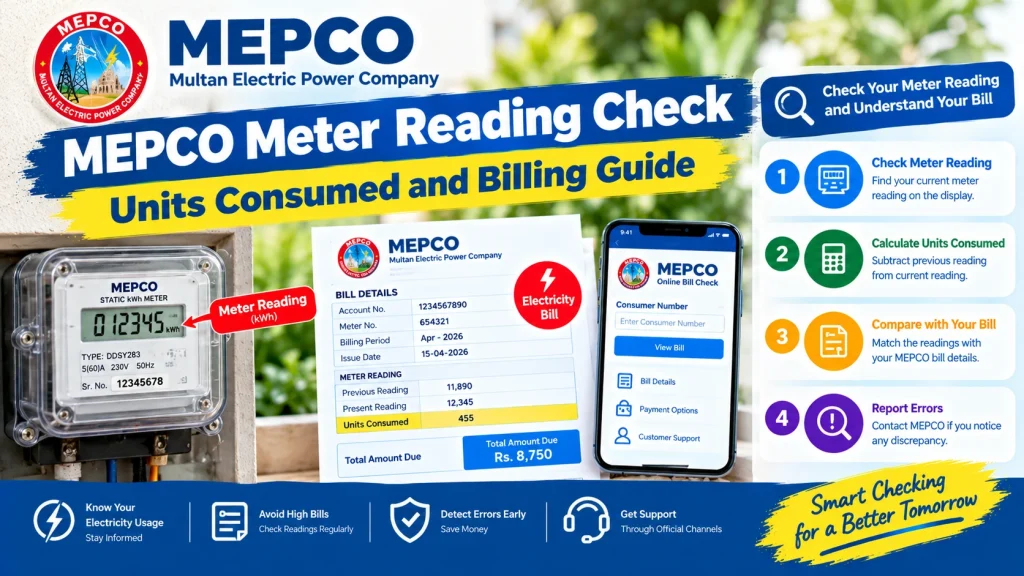
MEPCO Meter Reading Check – Step-by-Step Guide
A MEPCO meter reading is the measurement recorded by your electricity meter to determine how much electricity your household or business has consumed during a billing period.
Electricity consumption is generally measured in kilowatt-hours (kWh), commonly called units. For example, using 100 kWh of electricity means you have consumed 100 units.
MEPCO records meter readings to prepare monthly electricity bills. Your bill generally shows the previous reading, present reading, reading date, and total units charged. Comparing these details helps you understand how your electricity consumption is calculated.
The Ministry of Energy’s electricity billing guidance also explains that consumers can check their consumption by reading their meters and reviewing the meter-reading information printed on their bills.
How to Check Your MEPCO Meter Reading
You can check your electricity meter yourself by following these simple steps.
Step 1: Locate Your Electricity Meter
Find the electricity meter installed at your home, shop, or office. It may be outside the property, near the entrance, or in a designated meter box.
Step 2: Identify the Reading Display
Look at the digital screen or mechanical display on your meter. A digital meter may cycle through several values, including electricity consumption, voltage, and other measurements.
Identify the display showing the cumulative energy reading in kWh. If your meter has multiple registers, check the relevant register for your connection.
Step 3: Record the Current Reading
Write down the displayed kWh reading and the date when you checked it. Taking a clear photograph can also help you compare your reading with the next bill.
For meters that show decimal digits, follow the reading format used by MEPCO. Do not automatically include every decimal digit without checking your meter and billing instructions.
Step 4: Open Your Latest MEPCO Bill
Find the previous meter reading, present meter reading, and units consumed on your electricity bill. The exact layout can vary, so look for these labels rather than relying on a fixed position.
Step 5: Compare the Readings
Compare the reading on your meter with the present reading recorded on the bill, taking into account the bill’s reading date. Your meter will usually show a higher cumulative value as time passes.
If the figures appear inconsistent, first check the dates, meter number, display register, and reading format. A difference does not automatically prove that the bill is incorrect.
How to Calculate MEPCO Units Consumed
Calculating electricity units is straightforward when you have the previous and present readings.
Formula:
Units consumed = Present meter reading − Previous meter reading
For example, suppose your previous meter reading was 12,450 and your present reading is 12,780.
- Previous reading: 12,450
- Present reading: 12,780
- Units consumed: 12,780 − 12,450 = 330 units
In this example, the meter recorded 330 units between the two readings.
This calculation assumes a standard cumulative meter with a multiplier of 1 and no special circumstances. If your connection uses a meter multiplier, separate registers, net metering, or another billing arrangement, the billed consumption may require additional calculations.
Remember that units consumed are not the same as the total bill amount. Your payable amount can also include applicable electricity rates, taxes, adjustments, fixed charges, and other bill components.
How to Compare Your Meter Reading With Your MEPCO Bill
After calculating your consumption, check whether the bill details make sense.
Review these important fields:
- Previous reading: The meter reading recorded during the previous billing cycle.
- Present reading: The reading recorded for the current bill.
- Reading date: The date when the electricity meter was read.
- Units consumed: The electricity consumption charged for the billing period.
- Meter number: The identifier of the physical meter installed at your property.
- Billing period: The period covered by the bill.
Compare the meter number printed on your bill with the number on your actual meter. This is particularly important if several meters are installed close to one another.
Also check the reading dates. If the billing period is longer than usual, consumption may be higher simply because electricity was measured over more days.
MEPCO’s meter-reading guidance and NEPRA’s Consumer Service Manual describe the recording of meter readings and the information included in electricity bills. You can review the official MEPCO website and NEPRA website for relevant consumer information.
Why Is Your MEPCO Bill Higher Than Expected?
A high bill does not always mean the meter reader made a mistake. Several factors can increase your electricity charges.
Increased Electricity Usage
Air conditioners, electric heaters, water pumps, irons, and other appliances can increase monthly consumption. Compare your current units with previous bills to identify changes.
Longer Billing Period
If the current billing period contains more days than the previous one, your total consumption may be higher even if your daily usage has not changed significantly.
Incorrect or Estimated Reading
Sometimes a bill may be based on an estimated reading rather than an actual meter reading. Check the bill details and contact MEPCO if you believe the consumption has been calculated incorrectly.
Meter or Billing Discrepancy
A meter fault, incorrect account details, or a reading recorded against the wrong meter may require investigation. Keep a photograph of your meter reading and a copy of the bill to support your complaint.
Changes in Tariff or Charges
Even when your units remain similar, the payable amount may change because of applicable tariff rates, taxes, adjustments, or other charges.
What to Do If Your MEPCO Meter Reading Is Incorrect
If your actual reading and bill appear inconsistent, take these steps before making assumptions.
- Take a clear photograph of your meter display, including the meter number if possible.
- Keep a copy of your latest bill showing the previous and present readings.
- Check the billing period and confirm that you are comparing readings from the correct dates.
- Contact your local MEPCO subdivision or customer service centre and explain the discrepancy.
- Provide your reference number, meter details, bill copy, and photograph if requested.
- Ask for the complaint reference number so you can follow up on the matter.
You can start by visiting the official MEPCO website to locate relevant customer-service information. If the issue remains unresolved, consult NEPRA’s official website for information about the applicable complaint process.
Do not attempt to open, repair, or tamper with the meter yourself. Meter inspection and technical work should be handled by authorised personnel.
Tips to Monitor Your Monthly Electricity Consumption
Regular monitoring can help you understand your electricity usage and manage your expenses.
- Record your meter reading on the same date each month.
- Take a photograph to keep a record of each reading.
- Compare your monthly units with previous bills.
- Switch off appliances when they are not needed.
- Use energy-efficient lighting and appliances where practical.
- Check your bill’s reading dates and consumption before the due date.
These simple habits can help you identify unusual changes early and make better decisions about electricity use.
Frequently Asked Questions
How can I check my MEPCO meter reading?
Locate your electricity meter, identify its cumulative kWh display, record the reading and date, and compare it with the present reading printed on your latest MEPCO bill.
How do I calculate MEPCO units consumed?
Subtract the previous meter reading from the present reading. For a standard meter with a multiplier of 1, the difference gives the units consumed during that period.
Can I check my MEPCO meter reading online?
You can check the billing information available through MEPCO’s official services and compare it with your physical meter. The online bill may not display a live, real-time meter reading.
What should I do if my MEPCO bill shows the wrong reading?
Keep a bill copy and a clear photograph of your meter display. Contact your local MEPCO subdivision or customer service centre and request verification of the reading.
Why are my billed units different from my calculation?
Possible reasons include different reading dates, estimated billing, a meter multiplier, multiple registers, or a special metering arrangement. Check these details with MEPCO before concluding that an error has occurred.
Conclusion
The MEPCO Meter Reading Check process helps you understand your electricity consumption and compare your actual meter reading with your monthly bill. By recording your reading, calculating units consumed, and checking the billing dates, you can identify unusual changes and spot possible discrepancies.
If the reading on your bill appears incorrect, keep the relevant evidence and contact MEPCO for verification. Regular monitoring can help you understand your electricity usage, manage expenses, and address billing problems promptly.