
MEPCO Protected vs Non-Protected Consumers Explained
Electricity bills can vary significantly depending on whether a household is registered as a protected or non-protected consumer. Many MEPCO customers notice that two households using similar electricity units may receive different bills because their consumer categories are not the same.
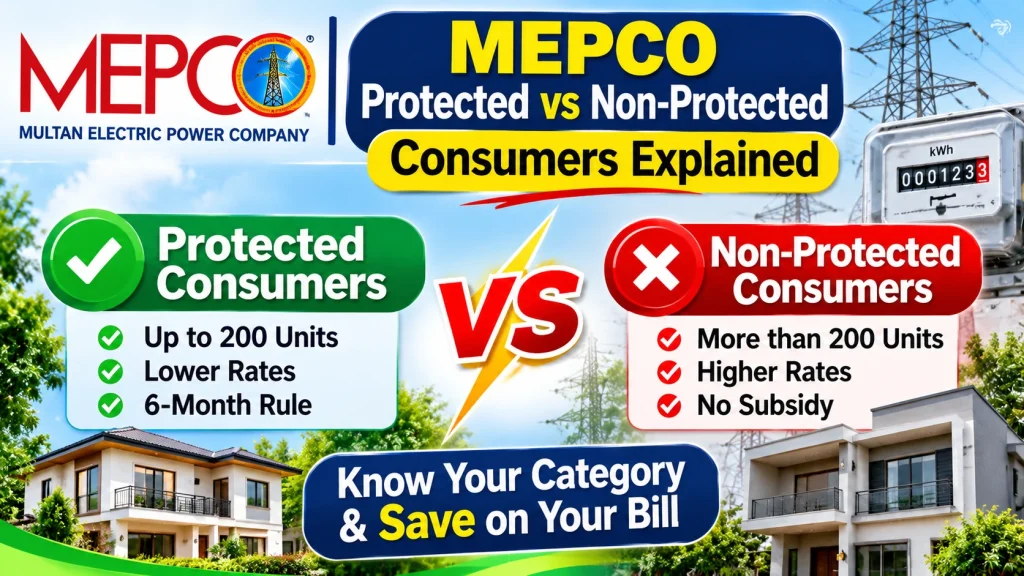
Understanding MEPCO Protected vs Non-Protected Consumers is important because the category determines which electricity tariff applies to your monthly consumption. Protected consumers generally receive subsidized electricity rates, while non-protected consumers pay standard residential tariff rates.
In this guide, you will learn the difference between protected and non-protected consumers, the 200-unit rule, six-month eligibility requirements, electricity tariff differences, and how your consumer category can change.
1. What Are MEPCO Protected Consumers?
Protected consumers are residential electricity users who consistently consume 200 units or less per month during the previous six months.
According to NEPRA’s tariff definition, protected consumers must meet the eligibility requirements under the applicable residential non-Time of Use (Non-ToU) category.
These consumers receive subsidized electricity rates compared with non-protected residential users.
You can check the latest electricity tariff rates and official updates through the NEPRA Official MEPCO Tariff Page.
Main Requirements for Protected Consumers
- Must have an eligible residential electricity connection.
- Monthly consumption should remain at or below 200 units.
- Must maintain the required consumption pattern for six consecutive months.
- Must fall under the applicable Non-ToU residential category.
For example, if a household uses 120, 150, 180, 160, 190, and 175 units during six consecutive months, it meets the consumption threshold for protected classification, subject to other eligibility requirements.
2. What Are MEPCO Non-Protected Consumers?
Non-protected consumers are residential electricity users who do not meet the protected category requirements.
If your monthly electricity consumption exceeds 200 units, you may move into the non-protected category.
Similarly, consumers who have not maintained the required six-month consumption history may also be classified as non-protected.
Main Characteristics of Non-Protected Consumers
- They do not qualify for protected electricity tariff benefits.
- Their electricity rates are generally higher.
- They may pay different rates depending on their monthly consumption slab.
- Fixed charges and applicable taxes are added to their electricity bills.
For example, if a household consumes 225 units during a billing month, it may lose its protected status and become subject to non-protected tariffs.
3. MEPCO Protected vs Non-Protected Consumers: Main Differences
Understanding the differences between these two categories can help you manage your electricity expenses.
| Feature | Protected Consumers | Non-Protected Consumers |
|---|---|---|
| Monthly consumption | Up to 200 units | Does not meet protected criteria |
| Eligibility | Six-month consumption history | Fails protected requirements |
| Electricity rates | Subsidized rates | Standard residential rates |
| Bill amount | Generally lower | Generally higher |
| Tariff category | Protected | Non-protected |
| Slab benefit | Applicable under tariff rules | Not applicable |
The most important difference is the electricity tariff. Protected consumers receive lower rates, while non-protected consumers pay higher applicable rates.
4. What Is the 200 Units Rule in MEPCO Billing?
The 200-unit rule is one of the most important factors in determining your electricity consumer category.
Under this rule, eligible residential consumers must maintain monthly consumption of 200 units or less consistently for six months to qualify as protected consumers.
If your electricity consumption exceeds 200 units, you may lose protected status.
For example:
- January: 145 units
- February: 160 units
- March: 180 units
- April: 190 units
- May: 205 units
- June: 150 units
Because consumption exceeded 200 units in May, the consumer may become non-protected.
According to the government explanation of the policy, a consumer who exceeds the 200-unit threshold must maintain the required lower consumption pattern for the following six months before becoming eligible again.
5. How Do Electricity Rates Differ Between Protected and Non-Protected Consumers?
Electricity tariff rates are different for protected and non-protected consumers.
Protected consumers receive subsidized rates, while non-protected consumers pay standard residential rates.
The applicable rates depend on the official tariff schedule notified by the government and NEPRA.
Your final MEPCO bill may also include:
- Electricity consumption charges.
- Fixed monthly charges.
- Fuel Price Adjustment (FPA), where applicable.
- Quarterly Tariff Adjustment (QTA), where applicable.
- General Sales Tax (GST).
- Electricity duty and other applicable surcharges.
Because electricity tariffs can change through official notifications, always check the latest rates before estimating your bill.
6. How to Check Your MEPCO Consumer Category
If you want to know whether your electricity connection is protected or non-protected, follow these steps:
Step 1: Check Your Latest MEPCO Bill
Download your latest electricity bill and review your consumer information and tariff details.
Step 2: Review Previous Six Months
Collect your previous six electricity bills and check the monthly consumed units.
Step 3: Check the 200 Units Limit
Make sure your monthly consumption remained at or below 200 units throughout the required period.
Step 4: Identify Your Tariff Category
Check whether your connection falls under the eligible residential Non-ToU category.
Step 5: Contact MEPCO
If your consumer category appears incorrect, contact your relevant MEPCO subdivision or customer service office for clarification.
7. How Can You Maintain Protected Consumer Status?
If you qualify for the protected category, maintaining your monthly electricity consumption is important.
Here are some practical ways to reduce electricity usage:
- Turn off unnecessary lights and electrical appliances.
- Use energy-efficient LED bulbs.
- Avoid running air conditioners unnecessarily.
- Use energy-efficient fans and refrigerators.
- Monitor your electricity meter regularly.
- Avoid unnecessary use of high-power appliances.
Remember that staying below 200 units in one month alone does not automatically guarantee protected status. The required six-month consumption history also matters.
Frequently Asked Questions (FAQs)
1. What is a protected consumer in MEPCO?
A protected consumer is an eligible residential Non-ToU electricity user who consistently consumes 200 units or less per month during the previous six months.
2. What is the difference between protected and non-protected consumers?
Protected consumers receive subsidized electricity rates, whereas non-protected consumers pay standard residential tariff rates.
3. What happens if I use more than 200 electricity units?
You may lose protected status and be moved to the non-protected category. You generally need to maintain eligible consumption for the following six months to qualify again.
4. Can I become a protected consumer again?
Yes. You may regain protected status after meeting the applicable consumption requirements for six consecutive months.
5. Do protected consumers pay less electricity bills?
Generally, yes. Protected consumers benefit from subsidized electricity tariffs, which can reduce their monthly electricity expenses.
6. How can I check my MEPCO protected status?
Review your latest electricity bill, previous six months of consumption, and applicable tariff category. You can also contact MEPCO for confirmation.
7. Are commercial consumers eligible for protected status?
No. The protected and non-protected classification discussed in this guide applies to eligible residential consumers, not ordinary commercial connections.
Conclusion
Understanding MEPCO Protected vs Non-Protected Consumers helps electricity users identify their applicable tariff category and manage monthly expenses. The 200-unit consumption limit and six-month eligibility requirement are important factors in protected consumer classification.
If you want to maintain protected status, monitor your monthly electricity consumption and avoid unnecessary electricity usage. Always check your latest MEPCO bill and official NEPRA tariff notifications to stay informed about applicable electricity rates and billing rules.